A Japanese university student
generously sent me the ad, along with others, some very old,
which were part of a paper she wrote about
the history of the Japanese menstrual
products industry.
And, of course, the first Tampax AND -
special for you! - the American fax
tampon, from the early 1930s, which also
came in bags.
See a Modess True
or False? ad in The American Girl
magazine, January 1947, and actress Carol Lynley in
"How Shall I Tell My Daughter" booklet ad
(1955) - Modess . . .
. because ads (many dates).


|

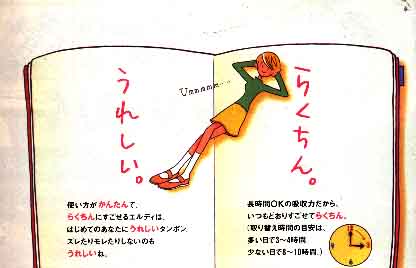
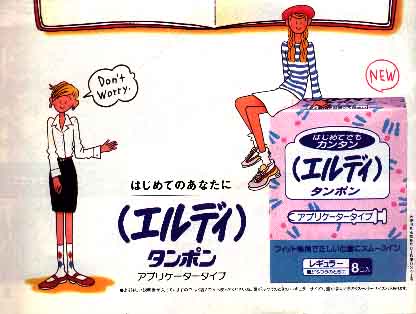
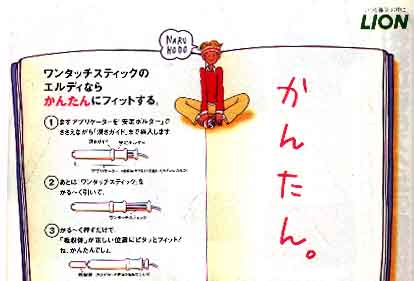
Ad for Elldy menstrual tampon (Japan),
Junie magazine (October 1996)
Japanese women, as I understand
it, favor pads to tampons by a
wide margin. In general, it seems to me
that women in strongly
patriarchal societies like Japan
use pads (or nothing at all,
which these Indian
directions refer to) much
more than tampons. I
think that's the case in most of
Asia and the Spanish-speaking
world.
My theory, which
can't be
original:
|
Men
in strongly
patriarchal
societies want to
know when women are
menstruating so they
can treat them
specially, often
badly, by Western
standards at least.
Tampons allow women to
completely or almost
completely conceal
their period, eluding
that control.
(Reusable cups
and sponges
conceal even better,
since a woman has
nothing to throw away
each time she uses
it.)
A
society that
believes
menstruating women
exert a special
power has a stake in
knowing when women
are menstruating
- if I believed that,
I would want to know
too! Hey, it's
important that wine
and crops not be
ruined! Menstruation
is also an indication
that a woman is not
pregnant.
Remember,
there are many people
today who believe in
the Evil
Eye, a topic
as interesting as
menstruation.
Menstruation has and
certainly had a
similar importance in
many societies.
|
Note the English in the ad,
probably simple so that most
school girls could read it.
English has status in many popular
cultures of the world (see a German
panty-pad ad using English),
and I think the ad uses it to seem
"with it." Most of the prestigious
scholarly publications of the
world are in English, making it
advantageous for scientists and
academics to learn it.
But the girls' eyes are
Caucasian (the lines are
vertical), the hair light, giving
the impression that these are Western
girls encouraging their Japanese
counterparts to try Elldy.
Japan is slowly allowing women to
have more of a say outside the
home (where women rule), and this
ad seems to be a sign of that,
especially when the girls seem so
young.
I wish I could translate the
text for you - and me. Can a
reader?
|
A reader DID respond, in January 2001:
Hi!
You had two questions on your
Web site about Japanese tampon
companies using English.
The first one (why are the instructions
for opening the Elldy tampon
packet in English?) is pretty
simple. English
is a decorative
language in Japan,
much in the same way that
you'll see random Chinese
characters (usually misprinted
or completely out of context)
on clothes and hats in the US
just because it looks cool.
Except
that in Japan they've been
using English as a decorative
language for years and years
and years now. With
something as simple as "open"
you really can't go wrong, but
for some really funny examples
of "Engrish" I recommend you
going to www.engrish.com.
(A good example of "Engrish" on
your museum's Web site would be
the Elddy tampon instructions
that say "Let's
enjoy tampon life!")
As for the girl saying "ummm,"
that's also pretty simple.
That's just the ad using roman
characters to spell out Japanese
onomatopoeia (Roma-ji). She's just
sighing comfortably.
[The
writer later added:]
I'm just
a regular Jane Schmoe that happened
to grow up in Japan.
You have
a GREAT museum!
|
 |
 |
Above: the left page in the
two-page ad. The girl relaxing at
top says, "Ummmmm . . . . . .,"
for which I have no explanation.
|
 |
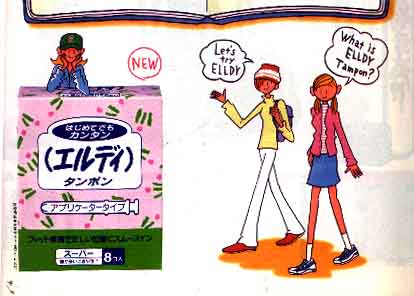 |
| Above:
the right -hand page of the ad. |
A Japanese university student generously
sent me the ad, along with others, some very old,
which were part of a paper she wrote about
the history of the Japanese menstrual
products industry.
© 2000 Harry
Finley. It is illegal to reproduce or
distribute work on this Web site in any
manner or
medium without written permission of the
author. Please report suspected violations
to hfinley@mum.org
|