See a roughly contemporary pad, Society, and a "silent purchase" ad for
Modess, 1928.
Other Modess ads: 1931,"Modess
. . . . because" ads, the French Modess, and the
German "Freedom"
(Kimberly-Clark) for teens.
See a prototype
of the first Kotex ad.


|

The perfect menstrual pad 1
(2 2a
3 4
4a 5)
"Report of Gilbreth, Inc.,"
to the Johnson & Johnson company, 1 January
1927, about how
to improve the company's menstrual products,
especially in competition with Kotex pads
In the mid 1920s, R. W. Johnson, of the
Johnson & Johnson company, U.S.A., asked
efficiency expert Dr.
Lillian Gilbreth to
find out what women liked and disliked about
menstrual pads, belts, and the various
menstrual underwear available, and gather information to make
the One Best Pad.
Later, Gilbreth became known as "the
mother of modern management" as well as
of twelve
children (read
her biography) sired by her
husband, Frank, likewise an efficiency
expert, who died in 1924. Some
of the children wrote the popular books
Cheaper by the
Dozen and Belles on Their Toes
about their childhood with famous - and
efficient - parents. Hollywood made
movies of the books in the late 1940s
and early 1950s.
In the mid 1920s American women used Kotex pads far more
than any other commercial napkin - commercial tampons
didn't appear until the early 1930s, and
menstrual cups
probably in the 1930s - and Johnson wanted
to find out why. His own brands, Lister's, Nupak and Modess, competed
with dozens of brands for the rest of the
market.
|
|
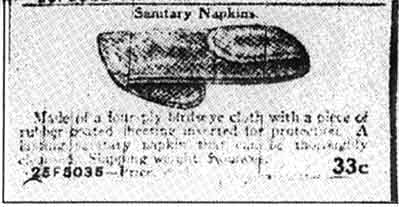
By the time of the report, 1927, commercial disposable pads
had mostly replaced washable pads (above, a commercial
washable from the Sears, Roebuck catalog,
fall 1921, which also advertised disposables.)
The ad text, above, reads, "Made of a four-ply
birdseye cloth with a piece of rubber
sheeting inserted for protection. A
lasting sanitary napkin that can be
thoroughly cleaned. Shipping weight, 5
ounces." Women had often made their
own pads from birdseye cloth, also used for
children's diapers.
|
Gilbreth gave questionnaires
to college students, including some at
Smith, Wellesley, New Jersey College for
Women, Antioch, as well as to some business
women and high school girls, and got back
1037 out of 2543 distributed.
She asked them about their napkin and belt practices,
including whether or not they altered the
pads, why and how, before wearing them; how
many they used; where they bought them; etc.
The respondents wrote what they liked and
disliked about products and suggested
improvements.
|
I will cover a few
topics of the report, and give her
conclusions and recommendations, many of
which are valid today.
In sum, the 134-page typewritten report,
with tables of statistics but no
illustrations, constitutes probably the first formal
analysis of women's attitudes about
menstrual products. Up to that
point, manufacturers seemed to base their
pads and belts on nineteenth-century
products - and their intuition. Lillian
Gilbreth and Johnson & Johnson changed
that.
The copy of the report that I read,
which might be unique, rests in the
special collections of Purdue University,
West Lafayette, Indiana, U.S.A. Dr.
Gilbreth was the first woman engineering
professor at Purdue.
© 2000 Harry
Finley. It is illegal to reproduce or
distribute work on this Web site in any
manner or medium without written
permission of the author. Please report
suspected violations to hfinley@mum.org
|
|