|


|

THE MUSEUM OF MENSTRUATION AND WOMEN'S HEALTH
German washable menstrual pads and
belt, with case (about 1935-40)
The majority of German women used
washable pads made at home - if they
used anything at all (read about using nothing)
- until Camelia (see an early
ad) appeared, the first widely
successful toss-away pad in Germany,
in 1926 (national
advertising of Kotex, America's
first widely successful disposable,
started in 1921.) (The information
comes from Zur
Geschichte der Unterwäsche.
1700-1960; details in small type,
below)
In 1940 German women probably saw
these pads and belt as not really old
fashioned, especially since their
country was fighting a war and
throwing away used pads was wasteful
(as it is today, really). Commercial
tampons probably didn't appear till
after the war, perhaps brought by
Americans, and the German native brand
(and maybe the first commercial one in
Europe), o.b. - which doesn't
have anything to do with obstetrics,
as many Americans have told me, but
stands for the German ohne Binde, "without a napkin" (proof) - appeared
in the early 1950s (see an early ad).
See an American
belt from roughly this date.
The pictures and technical
information come from Junker, Almut
and Stille, Eva.: Zur Geschichte der
Unterwäsche. 1700-1960. Eine
Ausstellung des Historischen
Museums Frankfurt 28. April bis
28. August 1988; FfM,
Germany (Historisches Museum) 1988,
the catalog of an exhibit in the
history museum of Frankfurt am Main,
Germany, in 1988.
|
|
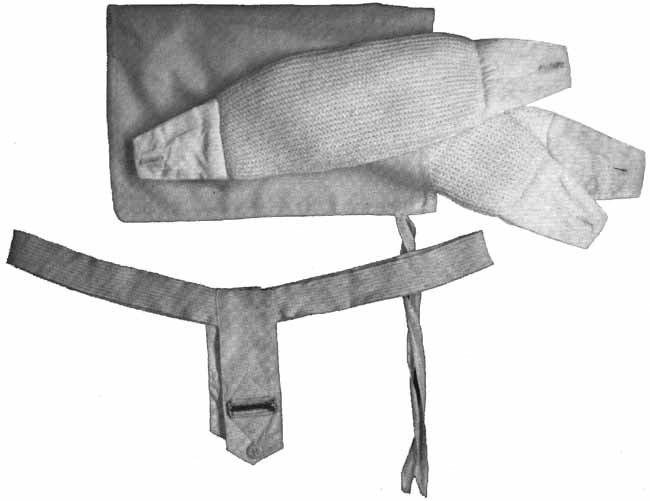
The belt is pink
(rosa), made of rubber and cotton
fabric. The cotton
sack holds the pads (details
below) and belt.
Enlargements lie below.
|
|
|
Bottom
pictures
(enlargements of parts of
the top picture):
Left:
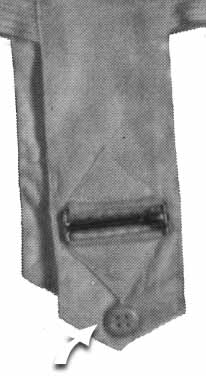
The arrow points to a glass
button on the
cotton belt-attachment;
directly above it is a metal
clamp or fastener (Klammer),
which I think acts to
support the button.
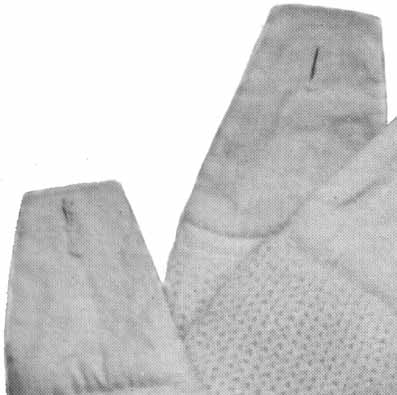
Right:
Button
holes in the ends
of the washable pads, which
are made of machine-knitted
white cotton and white
cotton fabric.
|
|
© 2001 Harry Finley. It is
illegal to reproduce or
distribute work on this Web
site in any manner or medium
without written permission
of the author. Please report
suspected violations to hfinley@mum.org
|
|
|