See a modern bowl for
soaking used pads.
See how a woman wore
a belt in a Dutch ad. See a classy 1920s ad for a
belt and the first ad (1891) MUM has for a belt.
See how women wore
a belt (and in a Swedish ad). See a modern belt for
a washable pad
and a page from the 1946-47 Sears
catalog showing a great variety.
More ads for
napkin belts: Sears,
1928 - modern
belts - modern washable - Modess, 1960s
Actual belts in the museum
And, of course, the first Tampax AND -
special for you! - the American fax
tampon, from the early 1930s, which also
came in bags.
See a Modess True
or False? ad in The American Girl
magazine, January 1947, and actress Carol Lynley in
"How Shall I Tell My Daughter" booklet ad
(1955) - Modess . . .
. because ads (many dates).


|

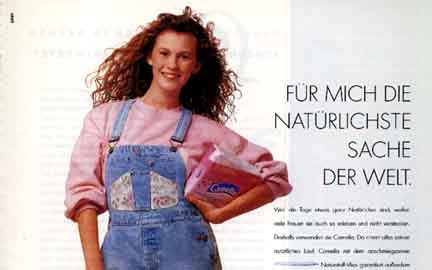
Ad for Camelia menstrual pad
(1990, Germany)
By the 1990s many companies
world wide put small pouches
into their packages of pads so a
woman could carry a single one,
concealing it, and use it to
contain the used pad before
throwing it away. (Here are ads
for New
Freedom and Whenever
showing pouches, and here are pouches found
near toilets to contain used
pads.)
In addition, Camelia, the second
German disposable pad - Hartmann's
Mulpa
was the first - demonstrates here
a very different
attitude from its American
counterparts.
The woman, below - she looks
like a teenager - openly carries
the package of pads; the
heading reads, "For me, the most
natural thing in the world."
Contrast this with the emphasis on
shame in an
American Kotex ad
for teenagers from two years later
and in an ad
for a tampon from the 1970s,
which emphasizes the ease with
which it can be concealed.
By the way, the maker of Kotex
bought the Camelia company in the
late 1990s - the first widely
successful disposable pad in
America buying the first widely
successful one in Germany. This
does not mean that Kimberly-Clark,
the new owner, will advertise the
products the same way. As we see
with another amazing ad for
Kimberly-Clark's German Freedom,
Kotex, like all companies,
advertises for the people who read
the ads, tailoring them to their
feelings.
Advertising
almost never tries to change
cultural attitudes - it exploits
them to make money, perfectly
understandable because the
bottom line is - the bottom
line. That's the business of
business.
See another Camelia
ad, from 1926
|
|
|
|
|
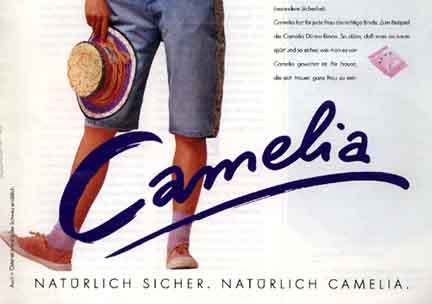
The large text
reads in my translation:
For me the most natural thing in
the world.
Camelia
Naturally safe. Naturally Camelia.
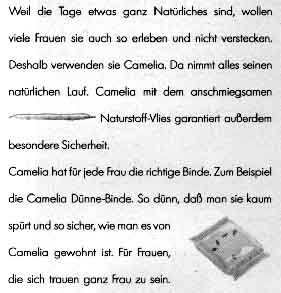
The small text
is below.
|
|
|
My translation
of the above text:
Because "the days" are completely
natural, many women want to
experience them as such and not
hide them. Thus they use Camelia.
Everything takes its natural
course. Camelia with the
close-fitting natural-fiber fleece
in addition guarantees
security.
There's a right Camelia pad for
every women. For example, the
Camelia Thin Pad. So thin that you
hardly feel it, and safe, as you
are used to with Camelia. For
women who are confident enough to
be complete women.
|
See another Camelia
ad, from 1926
© 2000 Harry Finley. It is illegal to
reproduce or distribute any of the work on
this Web site in any manner or
medium without written permission of the
author. Please report suspected violations
to hfinley@mum.org
|