See other underpants
- See belts that
hold pads - See suspenders
that hold pads
And read Lynn Peril's series about
these and similar booklets!
See more Kotex items: First ad
(1921) - ad 1928 (Sears
and Roebuck catalog) - Lee Miller ads
(first real person in amenstrual hygiene ad,
1928) - Marjorie
May's Twelfth Birthday (booklet for
girls, 1928, Australian edition; there are
many links here to Kotex items) - Preparing for
Womanhood (1920s, booklet for girls;
Australian edition) - 1920s booklet in
Spanish showing disposal
method - box
from about 1969 - "Are
you in the know?" ads (Kotex) (1949)(1953)(1964)(booklet, 1956) -
See more ads on the Ads
for Teenagers main page


|

Open-crotch
drawers (underpants) and
menstruation (late 19th century,
U.S.A.)
Although women sometimes wore
pants underneath their dresses for
riding or to keep warm, pants were
a symbol of men's power, and
women's underpants as such
apparently developed very slowly
around 1800 in Europe among the
upper classes, partly for
concealment of the genitals and
legs (Germans called them
"Beinkleider," "leg clothes," as
"Hose," the German word for pants,
referred to men's clothing and was
considered indecent when applied
to women.) For hundreds of years
before this time both men and
women of all classes wore the
shirt-like chemise,
day and night, as their only
underclothing.
In the 19th century, cumbersome and
sometimes huge dresses and
complex underclothing made it
practical for women to wear
underpants with a permanent
opening between the legs,
so they wouldn't have to reach
under and pull them down when
urinating or defecating. (This
raises the troubling question of how - or if - they cleaned
themselves afterward.
Folks did not think bathing was
healthy for a large part of that
century. I don't want to think
about this, actually. That
fortress-like clothing could have
served as an odor barrier. I'm
sorry I brought this up. But,
if you're game, or perhaps gamey,
check out the odor
page.)
Fewer and lighter clothes in the
early 20th century made open
crotches unnecessary - now pulling
underpants down was easy - and
underpants could then fulfill
their concealment function by
covering the genitals. But they
were still wide-leg and long (but
see this
exception for menstruation)
until the mid 1930s, when briefs for
women appeared in mass
markets.
Ultimately underpants functioned
to preserve
modesty, and in a century
when people covered their chair
and table legs because of their
suggestive nature, it's
understandable how long the ones
below are. High-top shoes covered
the lower leg, and drawers, with
lace covering the lower part - in
case someone peeked - covered much
of the rest, as you see.
(This raises another question:
did the can-can
dancers in late 19th
century Paris expose their vulvas
when kicking their legs up, since
open underpants were apparently
the fashion? If so, no wonder it
was scandalous! And I thought it
was just because they were showing
their undies.)
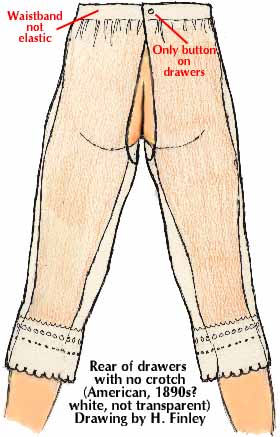
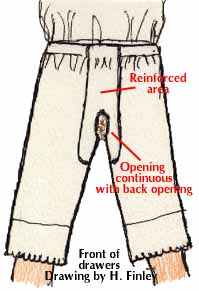
The museum has this pair, below,
made of linen. I will later post a
photo of them.
|
Rear view
|
Front view
|
|
|
|
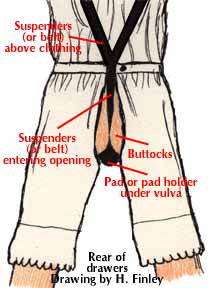
How a woman
could wear menstrual-pad suspenders over her
underclothing. (Here's
how she wore it under
all her clothing.)
|
Below, left: U.S.
patent No. 169, 245,
1875, granted to Stephen
Ellis.
The holders at the
bottom attach to the pad or pad
holder, often a trough.
|
The back strap has
farther to go and is longer - it
must pass over, or between, the
buttocks - as the vulva and
vaginal entrance are more toward
the front of the body (see a
drawing). Later, by popular
request (read part of the 1927 Gilbreth
report), commercial pads for belts
often had tabs of unequal length
because of this (see a Modess).
|
|

|

|
|
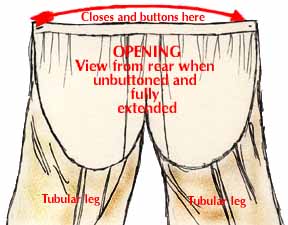
Open-crotch
underpants, unbuttoned and opened
wide, from the rear.
|
|
|
See other underpants
- See belts that
hold pads - See suspenders
that hold pads
Copyright 2001 Harry Finley
|