More menstrual and everyday
underpants
Japanese, early 20th
century - "Sanitary Bloomers,"
1922 (ad from Sears, Roebuck catalog, U.S.A.) - various
underpants, 1928 (page from
Sears, Roebuck catalog) - step-in, Hickory,
1928 (ad from Vanity Fair magazine, U.S.A.) - first
Sears everyday underpants
(nonmenstrual), 1935 (ad from Sears, Roebuck catalog) -
various underpants (and
belts), 1946-47 (page from Sears, Roebuck catalog) -
various underpants, 1960s
(part of Personal Digest, Modess, U.S.A.) - Modess Sanitary Shield (1972)
Ads for teens (see also introductory
page for teenage advertising): Are
you in the know? (Kotex
napkins and Quest napkin powder, 1948, U.S.A.),
Are you in the know? (Kotex napkins, 1953, U.S.A.),
Are you in the know? (Kotex napkins and belts, 1964,
U.S.A.), Freedom (1990, Germany), Kotex
(1992, U.S.A.), Pursettes (1974, U.S.A.), Pursettes
(1974, U.S.A.), Saba (1975, Denmark)
More ads for teens: See
a Modess True or False? ad in
The American Girl magazine, January 1947, and actress Carol Lynley in "How Shall I
Tell My Daughter" booklet ad (1955) - Modess . . . . because ads (many
dates).


|

SheShells underpants (1970s; U.S.A.)
I don't know if SheShells ever had a big
market, but it was another in a long line of
devices to overcome the limitations of pads
and tampons, such as their ability to hold
pads in place and to contain leakage from the
tampon or pad. It seems to be from a company
not associated with a pad manufacturer.
|
Below:
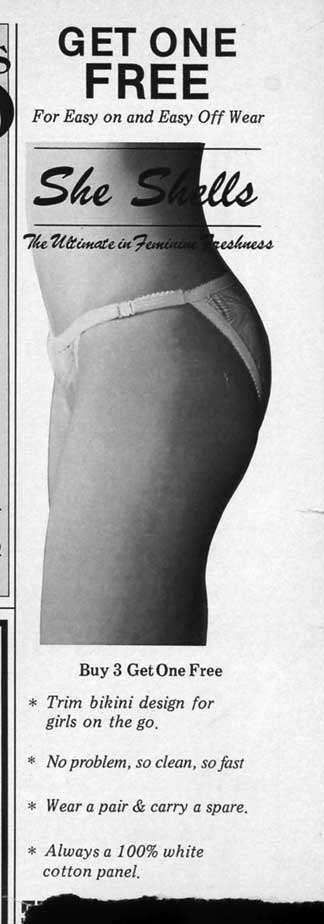
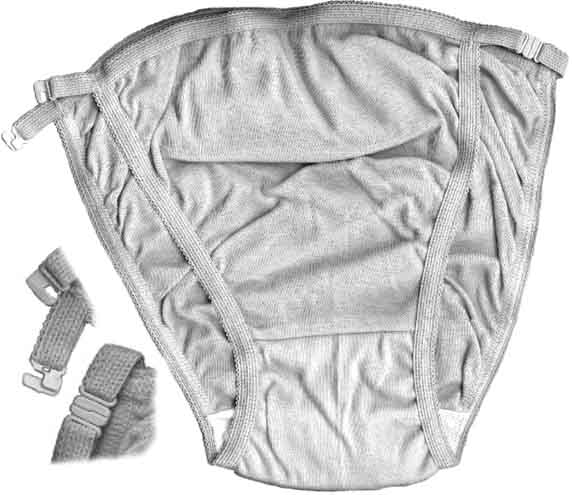
SheShells appeared in several colors
and sizes (this is a yellow size 7 -
large) and showed up in small
ads in at least one women's
magazine, Seventeen. Although the
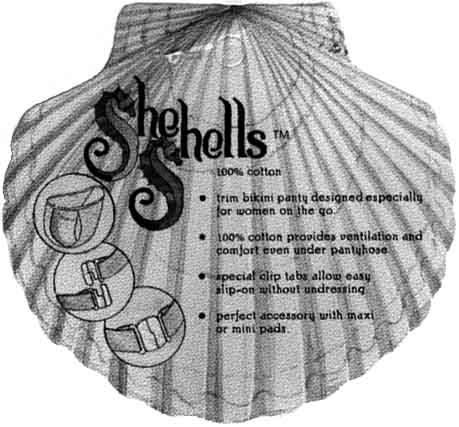
label (one section is below)
indicates it's useful for
menstruation, the crotch is the
usual double cotton layer with no
special protection for
blood leakage, such as plastic or
rubber; I suspect this was its
limitation.
Its virtue was that a woman could take
it off by unhitching the sides
so that she could keep her pants or
pantyhose on.
Betraying its post-belt-era origins
is the lack
of a special attachment for a pad
in the crotch, such as the
bands in the Modess Sanitary
Shield, which was also from
the 'Seventies. Pads at this time,
and today, stick to the bottom of
the panty, a great invention.
Although the bikini bathing
suit got its name from the
island where the 1946 atomic bomb
test occurred(a Paris designer named
it so because of the suit's
"explosive" effect), bikini-like
clothing - low-lying bottoms having
only a narrow band of material at
the sides - has been around for a
long time, appearing in a Sicilian mural
almost two thousand years ago.
Bathing suits since the last century
had been getting smaller and
smaller; this culminated in Rudi
Gernreich's topless suit in 1964,
which had a very high-cut bottom; so
much for the bikini.
|
|
Below: This is
probably an ad from Seventeen magazine,
probably in the 1970s. The ad is missing its
lower part.
|
|
|
|
This is one of two
identical color flap labels attached
to the underpants. I quibble, but I
think the stylized lettering is too
complicated - and maybe the sea
horses should be shells.
|
First Sears everyday
underpants (nonmenstrual), 1935 (ad
from Sears, Roebuck catalog)
More
menstrual and everyday underpants
Japanese,
early 20th century - "Sanitary
Bloomers," 1922 (ad from
Sears, Roebuck catalog, U.S.A.) -
various underpants,
1928 (page from Sears, Roebuck
catalog) - step-in, Hickory,
1928 (ad from Vanity Fair magazine,
U.S.A.) - first Sears everyday
underpants (nonmenstrual), 1935 (ad
from Sears, Roebuck catalog) -
various underpants
(and belts), 1946-47 (page from
Sears, Roebuck catalog) - various underpants,
1960s (part of Personal Digest,
Modess, U.S.A.) - Modess Sanitary
Shield (1972)
© 2011 Harry Finley. It is
illegal to reproduce or
distribute any of the work on this
Web site in any
manner or medium without written
permission of the author.
Please report suspected violations
to hfinley@mum.org
|
|
|
|