See
Dr. Grace Feder Thompson's
letter appealing for patients; Dr. Pierce's
medical empire; Lydia
E. Pinkham's fabulously successful
vegetable compound & trinkets &
publications; Dr. E. C. Abbey's The Sexual System and
Its Derangements (1882); Dr. Young's rectal
dilators; Orange
Blossom medicine; ad for Ergoapiol (1904),
an abortion substance; and Lysol douche liquid
ad, 1948 (U.S.A.)
YOUR
remedies for
menstrual period pain and problems. See
more remedies here.


|

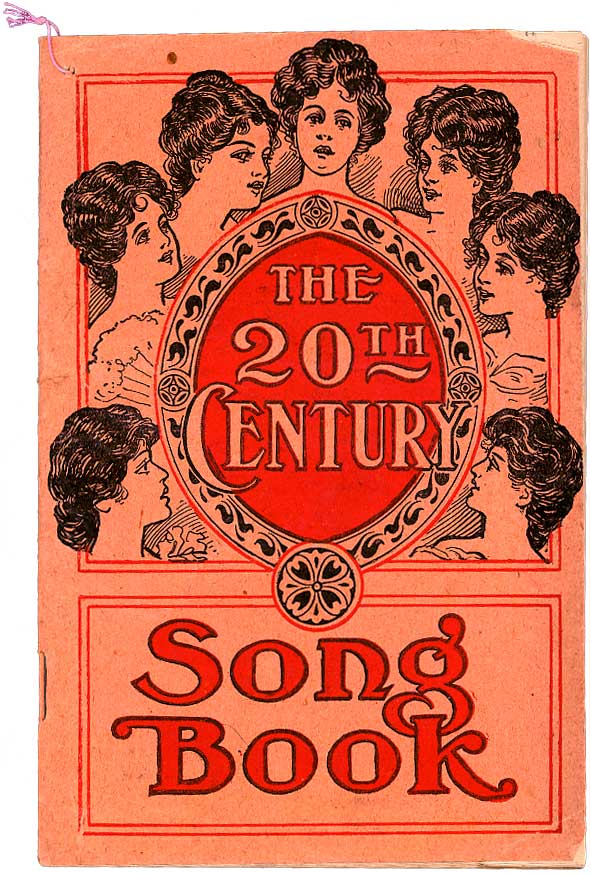
"The 20th
Century Song Book"
Chattanooga Medicine Company,
U.S.A., 1904
Complete booklet, 32 pages plus
covers
Although the following (much of
which appears in Home
Treatment for Women) applies
to this booklet as well as to
Cardui's Home
Treatment, this booklet
seems to feature women of a higher
social class - and men and many
animals, which the medicine also
helped. Many of the readers were
farmers or at least rural people,
judging by the testimonials.
Singing and playing musical
instruments at home was common before
radio and record players,
and rural people probably
appreciated the free music
interspersed with tips on curing
themselves and their animals - all
with Cardui and related products.
The booklet contains an
interesting description of the
size and nature of the company and
how it was started. No less than a
man of the cloth invented Wine of
Cardui, reassuring
readers with the godly
connection. But it gave a
good buzz.
Cardui, one of thousands of
patent medicines in the 19th and
20th centuries, seems to have
found favor mainly in the southern half of
the United States,
judging by the origins of the many
testimonials in this booklet.
Maybe the Chattanooga Medicine
Co., based in Tennessee,
distributed its bottles
and packets only to that area. But
this booklet lists factories in
San Francisco and St. Louis and,
of course, Chattanooga; and a
Martha Killian writes from South
Africa to praise the tonic.
One of the many afflictions
these three medicines - Cardui,
Black Draught, and Cardoseptic -
treated was "female
weakness," which the
unremitting housework and endless
childbirths and children might
have brought on (but men took it
too - and animals). Medicine, not
perfect today, was much less so in
the 19th and early 20th centuries
and the sick and tired often
looked to their druggists for
healing, just as we do today.
Think of all the supplements,
mostly unregulated, that we
swallow, alcohol
(see the Cardui label with
ingredients) among them.
Same thing back then.
And this is also the same: if
people wait long enough, with or
without medicine, many disorders
clear up by themselves, something
doctors know and knew. So during
the weeks and months and years
these folks imbibed Cardui and its
siblings some disorders would have
cleared up anyway.
Lydia
Pinkham made similar
cure-alls and became fabulously
successful.
Booklets like this are museums of rural
speech. Some words and
phrases are probably gone forever.
I would love to hear the speakers
of the time talk.
This booklet appeared before
radio began to smooth out regional
differences in the 1920s by
allowing listeners to hear
speakers far away from the little
towns and farms that many never
left. But my
stepmother, from North Carolina,
dumbfounded an elevatorful of New
Jersey residents in that state by
exchanging some words with my
father (a New Jerseyite). She
later laughed and said that one
person told her they did not know
people really spoke like that and
thought she was faking it. So even
today there are surprises. Vive
la différence!
As an artist
I find the illustrations fabulous,
better than the Wall Street
Journal's daily portraits of
people in the news. Drawing for
publication prevailed over
photography then, which had just
started in printed media a few
decades earlier so there was a
large number of experienced
artists available.
Midol
pain reliever pills for
menstruation: old tins
(containers), old ads, old
booklet
(selections)
YOUR
remedies for menstrual
period pain and problems. See more
remedies here.
|
Below:
Front cover. The paper
booklet measures 5 1/8 x
7 3/4" (about 13 x 19.8
cm) and has
a looped string,
probably for hanging
near the piano.
|
Below,
right: A
section of Charles Dana
Gibson's pen-and-ink
drawing "The American
Colony [in England],"
1899, five years before
the Cardui booklet.
Gibson's virtuosity
earned him a huge income
and he created
illustrations for books
and the leading American
magazines. He's better
than the artist of the Song
Book but you
see the same faces in
the young women;
compare this profile
with the one in the
lower right corner of
the Song Book (and see
a definite
case of
copying). You see the
same trend in Irving
Nurick's drawings for
Kotex (and
other companies)
decades later - but,
Oh! are the faces
from the two eras
different! Ideals
change.
Try drawing this with a
pen you have to dip
every few strokes; try
doing it any way you
want to see how hard it
is.
|
|
 |
 |
Below:
Gibson influenced
American
illustrators for
years, here, James
Montgomery Flagg,
known to you for
the poster "I
Want You for
[the] U.S. Army."
These two artists
were masters in
what is known as
the Golden Age of
American
Illustration. The
lady, by the way,
is about to make
the putt that the
gentleman at
right, whom I cut,
missed.
(See a girl
teaching her
mother to play
golf in a
Modess ad two
decades or so
later.)
|
 |
| |
|
Below:
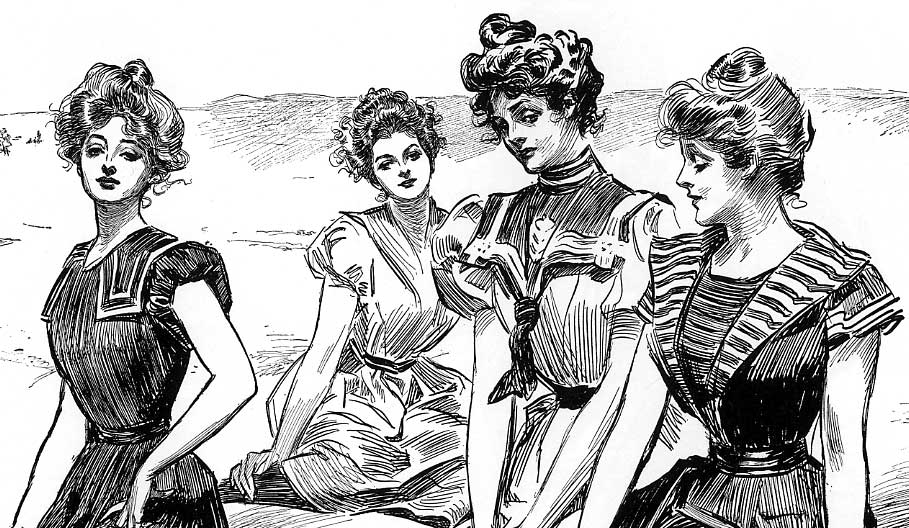
We know Gibson best for
the Gibson
Girl, below, in
bathing suits in Gibson's
book Americans
(1900).
Their hauteur
smolders on the
beach, but not from the
sun, and their hair never
touches the water.
(The Gibson pictures are
excerpted from The
Gibson Girl and Her
America, edited by
Edmund Gillon, 1969;
source unknown for the
Flagg.)
|
 |
|
© 2008 Harry Finley. It is illegal to
reproduce or distribute work on
this Web site in any manner or medium
without written permission of the author.
Please report suspected violations to hfinley@mum.org
|