Read 1930s criticism of
douche products Zonite
and Lysol. See Lysol information in old newspapers and Lysol ads from 1948 and 1934.
Visit the odor page.


|

Lehn & Fink New
Improved [menstrual, birth
control?]
Tampon with
hydroxyquinoline
(1930s-1940s? Lehn & Fink Products
Corporation [Lysol],
U.S.A.)
Lehn & Fink, which made Lysol,
supplied this tampon in two forms in one
box: with and without an
applicator, possibly unique at the
time. The applicator looks
suspiciously like the patented
Tampax applicator and I'm sure it
caught lawyers' attention.
Unable to let well enough alone,
L & F treated the cotton
absorbent plug with hydroxiquinoline,
an antiseptic and disinfectant,
which the company hoped would kill menstrual
odor (and not the
user). Safety data for
8-hydroxyquinoline at
http://msds.chem.ox.ac.uk/HY/8-hydroxyquinoline.html
indicate that
"[hydroxyquinoline is] [h]armful by
ingestion, inhalation and
through skin contact.
CNS [central nervous system]
stimulant. There is evidence
that this material can cause cancer
in laboratory animals. May act
as a mutagen
in humans. May act as an irritant."
[I added
the red.]
Just what
women needed in their vaginas! Unless they
wanted to kill sperm - birth
control.
And the
same company advertised another
disinfectant, Lysol, for douching - squirting up
vaginas - for "marriage
hygiene," which could mean birth control
as well as the emphasized odor control.
Was this
tampon also intended as a contraceptive? More: Birth
control and religion | Birth
control drugs, old | Birth
control douche
& sponges
Procter & Gamble kindly
donated the box and contents as
part of a gift of scores of
menstrual products.
|
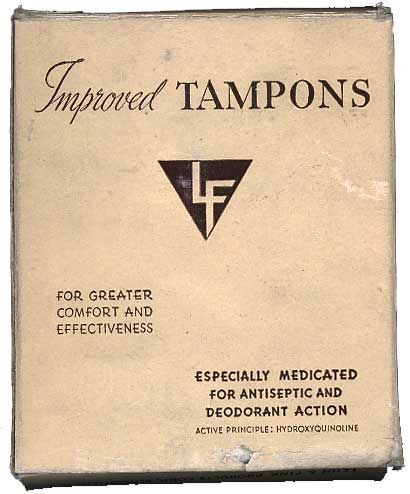
Below:
The cardboard box measures 3 1/2 x
4 1/4" x 1 3/8" (9 x 10.5 x 3.5
cm) and a brown
color appears throughout
the material.
Active
principle: I wonder what
the INactive principles were if
there were any.
|
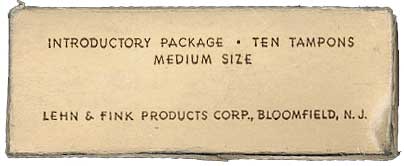
Below:
The ends and front and back of the
box are identical
but not the sides.
|
 |
In a practice
that some
companies have
revived recently
this
box
contained
both
tampons with
applicators (suspiciously Tampax-like) and those with none,
to be inserted
with fingers. I
haven't seen
other boxes of
the era with
both types. But
it seems to me
that was mistake: I would guess most women of that era
(and today) are
firmly of one
camp or the
other. But this
was an introductory
package;
maybe the
company was
trying to get an
idea of what the
customers wanted
and what it
could offer
them.
|
|
 |
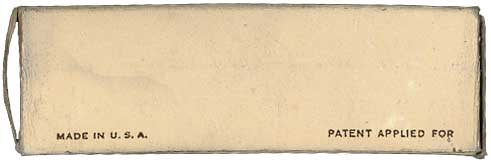
Below:
The side
opposite to the
one below is blank except for PRINTED IN U.S.A. in lower
center.
It's rare to see
any mention of patents in early American tampons, Tampax
being the great
exception. It
knew what it it
had.
|
|
 |
|
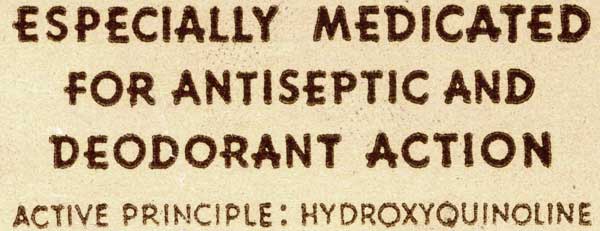
Below:
I enlarged the text from the lower
right part of the box to show the
beautiful
typeface.
But see a surprise
below this.
|
 |
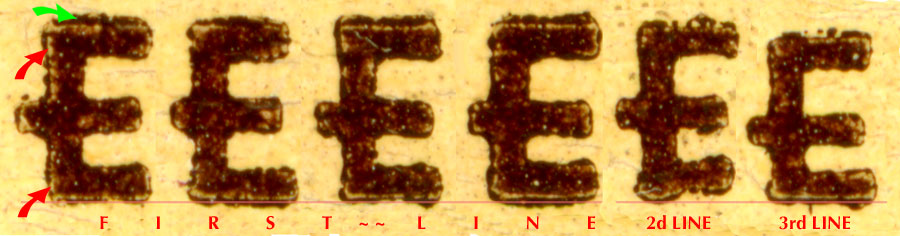
Below: I
ENLARGED all the E's
from the darker text and
compared them line
by line. Aren't
I industrious?
Do I have too
much time on my hands
as a British paper, I
think News of the World,
long ago wrote? But
this is interesting!
Look how the E's from
the first line are very
similar but not
identical, the
second-line E is
different and the
third-line one radically
so.
I believe this shows the
effects of the hand-placed
metal
type that was
used to print the box, a
process as old as
Gutenberg, and how the
different metal letters
wear down with use - and
how tough it was to cast
the metal type exactly
alike. (But it doesn't
explain why the E's in
the first line are so
similar and the others
are not.)
Most of you know the uniformity
of electronic
(digital) type
(compare),
something not available
when this box appeared.
Below,
the RED
ARROWS point to
the white
edge of the mark the
metal type made
and the GREEN
ARROW to the
ink that has spilled
outside the correct
area - at least
that's my interpretation
(I spent years as a graphic
designer.)
|
|
 |
NEXT: The tampons | Applicator tampon in
detail | Applicatorless
tampon
in detail | Instructions (side 1) (side 2)
Birth control and
religion | Birth
control drugs, old | Birth control douche & sponges Read
1930s criticism
of douche products
Lysol & Zonite and. See Lysol information in old newspapers and Lysol ads from 1948 and 1934. All tampons on this
site.
© 2008 Harry Finley. It is illegal to
reproduce or distribute any of the work on
this Web site
in any manner or medium without written
permission of the author. Please report
suspected
violations to hfinley@mum.org\
|