See how a woman wore
a belt in a Dutch ad. See a classy 1920s ad for a
belt and the first ad (1891) MUM has for a belt.
See how women wore
a belt (and in a Swedish ad). See a modern belt for
a washable pad
and a page from the 1946-47 Sears
catalog showing a great variety.
More ads for
napkin belts: Sears,
1928 - modern
belts - modern washable - Modess, 1960s
Actual belts in the museum
And, of course, the first Tampax AND -
special for you! - the American fax
tampon, from the early 1930s, which also
came in bags.
See a Modess True
or False? ad in The American Girl
magazine, January 1947, and actress Carol Lynley in
"How Shall I Tell My Daughter" booklet ad
(1955) - Modess . . .
. because ads (many dates).


|
MUSEUM OF MENSTRUATION AND
WOMEN'S HEALTH
Just
Between Us . . . (Beltx,
1961, U.S.A.)
Booklet for girls about menstrual
products
WHOA! What company would
actually use RED in discussing
menstruation? In America, very
few. It might remind women of, um,
menstruation, rather than little
birdies, flowers, daintiness, and
smelling like a rose rather than -
well, we dare not mention that.
(Smelling like menstrual blood was
actually a
way to snare men in at least one
factory in England. And
Americans think women would never
dare bleed
into their clothing. So,
what causes menstrual
odor?)
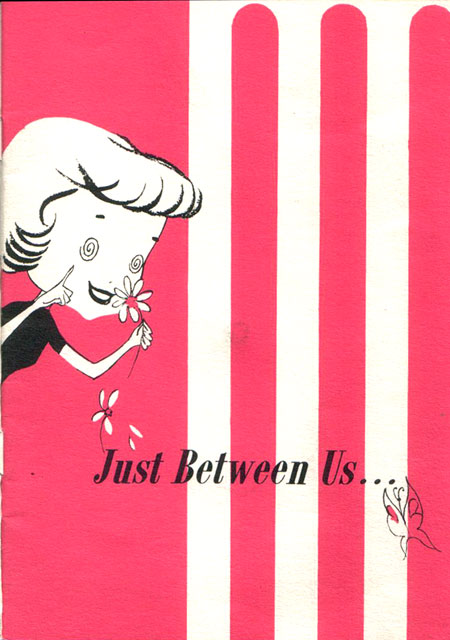
Betty Kay - that's her on the
cover, below - must have the nuttiest
eyes in menstrual products!
And she's smiling! This has to be
the boldest attempt ever to
combine cheerfulness - very
American, smiling at everything -
with PMS/menstruation. (The
naturalized American artist Saul
Steinberg said Americans look
serious only when looking at art
and when conversing about, or in
the presence of, the dead.
Americans wear masks, he said, and
he made masks for every occasion -
and wore them! But I can testify
that even at viewings of bodies in
funeral homes Americans will
doggedly smile.) The Dutch
contributor wrote about the eyes:
The girl on these pages has
very strange eyes, as if
they were blinded by a
flash, maybe the result of the
atomic era with the trials
of A- and H-bombs? :). Or was
that the look of the sixties?
Women wore commercial belts at
least from the latter part of the
nineteenth century (the earliest
ad the museum has is an American
one dated 1891).
Because self-adhesive pads became
available only in the early 1970s,
if women used pads, they had to
wear belts, suspenders,
"sanitary
panties," (underpants with
hooks or tabs or something else to
hold the pad in place) - or invent
some way of getting the pad to
stay in place.
Companies sold probably hundreds
of varieties of belts in the past
hundred years, but the industry
almost disappeared in the early
1970s with the advent of pads
with adhesive (Stayfree
and New
Freedom).
See the
complete 1950 edition.
I thank again the Dutch
contributor of many, many items
to MUM for scans of this
booklet!
|
Below left:
The Dutch contributor writes that
the booklet measures 13 x 18.5
centimeters, about 5 1/8" x 7
5/16". The
lady's nutty eyes perfectly
match the use of red just as her
smile matches the butterfly and
flowers: menstruation versus
concealment (of feeling as well
as menstruation itself).
Right: Look at
the similar eyes
of the Mad
Hatter (from Alice in
Wonderland in a late
20th-century version) on a
wrapper for - how
appropriate! - the
hallucinogenic drug LSD,
probably from the American
1970s. But LSD spun his
eyes in opposite
directions. (I lifted this
from an article
about LSD
wrappers from Spiegel
online, the German news
magazine site. Now
we're even: the magazine had lifted
my scan of the packaging
of the early birth-control
pill Enovid-E.)
And both are smiling,
making them even more
unnerving. But
at least Betty's not drooling.
Stay
out of their ways!
|
  |
Below:
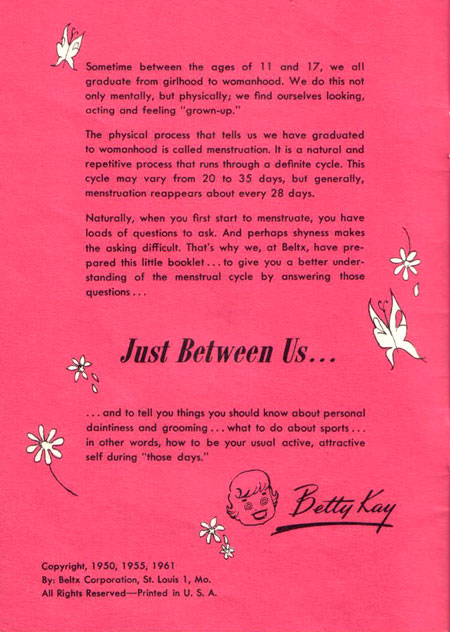
The inside front cover. Putting
quotes around grown-up is
the first of many such violations
of one of Strunk and White's Elements
of Style rules, that of
overuse of quotation marks. They
emphasize cutesiness and fit right
in with the flowers and birdies
and butterflies in trying to
conceal unpleasant aspects of
menstruation - for most women,
anyway. Girls see through this
pretty quickly. But see a flower used not to
euphemize menstruation but to announce
it!
|
 |
NEXT pages 11 12 13 14 15 inside back cover
- See the complete 1950 edition.
Many actual belts - Menstrual pad
suspenders! See
how women wore
a belt (and in a Swedish ad).
See a modern belt
for a washable pad
and a page from the 1946-47 Sears
catalog showing a great variety.
Menstrual panties.
© 2007 Harry Finley. It is illegal to
reproduce or distribute any of the work on
this Web site in any manner or medium
without written permission of the
author. Please report suspected violations
to hfinley@mum.org
|